
When my friend Gladys Toulis learned I had included Granada on my 2013 travel itinerary, she was thrilled! Gladys and her husband Bill*, both artists and ardent world travelers, had been to Granada, and loved it! In her email messages sent leading up to my departure, and while I travelled, she thoughtfully filled them with suggestions of places to visit and foods to try. And in one note, Gladys briefly and enthusiastically related the life story of early 20th century Spanish poet, playwright, artist, and social activist, Federico García Lorca.
In the modern Camino de Rondo area of Granada, we visited Parque Federico García Lorca, as well as, the Lorca museum, situated within that enchanting, lush, and fairy-tale like setting.
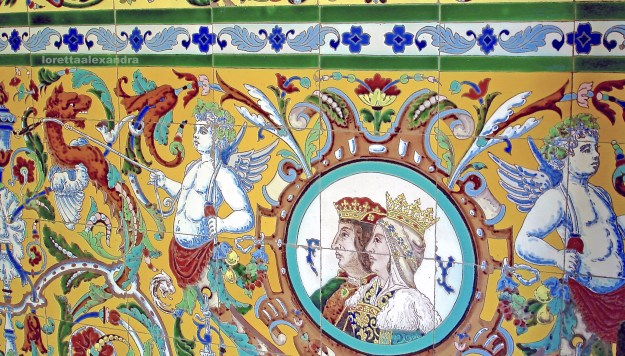
In Weimar, it was Goethe and Schiller, revered and celebrated; in Granada, it’s Los Católicos, the 15th century Catholic monarchs Ferdinand II, King of Aragon and Isabella I, Queen of Castile—husband and wife, second cousins…and my maternal 15th great grand-parents. Both Ferdinand II and Isabella I are descendants of John I of Castile. They were the driving forces behind the reconquest of Islamic Spain (including Granada) and the Spanish Inquisition, their goal being to unify the Spanish colonies and territories, and make all of Spain a Christian society by using the most brutal of tactics: forced expulsions, prosecutions, and executions.
I say, without hesitation, my favorite times in Granada, besides the day at Alhambra, and the afternoon at Parque Federico García Lorca, were the two consecutive days we spent high up in El Albayzín (the Albaicín) district of Granada, where we had traveled steep, narrow, winding cobbled streets to reach. The first time we ventured there—by taxi, of course—we were heading to the Bar Kiki, at the top of the hill. Kiki’s had been highly recommended for it’s excellent, traditional Moroccan cuisine. Besides great food (mine, a classic Moroccan dish—lamb-tangine cooked with aromatic spices, almonds and dates), before departing, we had an informative chat about the history of the area, with our server/manager, a friendly Moroccan native. Then, once outside, exploring the immediate surrounding area, we discovered an awesome view of the opposite hill, on which the Alhambra Palace is located.
After such a fine experience, the following evening, we returned to the Albaicín. Once again, we dined on rich and tasty Moroccan dishes. but in a more intimate, traditional ethnic setting. Seated surrounded by old family pictures, bric-a-brac type of objects and decorative light fixtures mounted on cerulean blue walls, the atmosphere was more reminiscent of a relative’s colorful, late 19th century, comfy dining room. A quaint and pleasant respite for visiting travelers!
*In 2016, Gladys lost her husband of more than 50 years, noted printmaker and Pratt Institute instructor, Vasilios “Bill” Toulis. And in 2017, I lost my friend of 50 decades, talented artist and Cooper Union classmate, long-time art educator, enthusiastic world traveller, and lover of people and different cultures, Gladys Toulis.

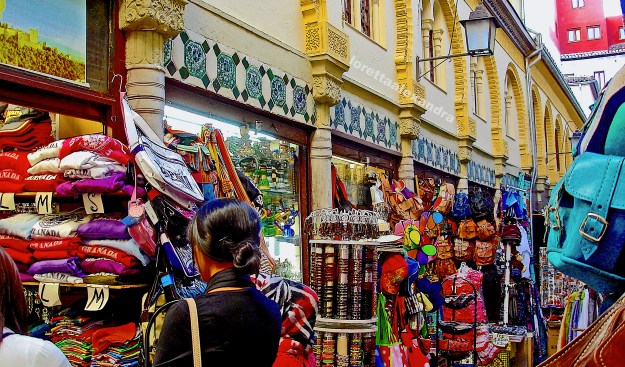
The Alcaiceria is a series of shops and stalls selling mostly ethnic clothing, fabrics, crafts, souvenirs, fruit, and Moroccan spices.
— The Alcaiceria, Granada’s vibrant and colorful Great Bazaar


Federico García Lorca
SPANISH WRITER
Written by: Leslie Anne Stainton
Federico García Lorca, (born June 5, 1898, Fuente Vaqueros, Granada province, Spain—died August 18 or 19, 1936, between Víznar and Alfacar, Granada province), Spanish poet and playwright who, in a career that spanned just 19 years, resurrected and revitalized the most basic strains of Spanish poetry and theatre. He is known primarily for his Andalusian works, including the poetry collections Romancero gitano (1928; Gypsy Ballads) and Llanto por Ignacio Sánchez Mejías (1935; “Lament for Ignacio Sánchez Mejías,” Eng. trans. Lament for a Bullfighter), and the tragedies Bodas de sangre (1933; Blood Wedding), Yerma (1934; Eng. trans. Yerma), and La casa de Bernarda Alba (1936; The House of Bernarda Alba). In the early 1930s Lorca helped inaugurate a second Golden Age of the Spanish theatre. He was executed by a Nationalist firing squad in the first months of the Spanish Civil War.
Read more of this article about Federico García Lorca: Encyclopedia Britannica


“I will always be on the side of those who have nothing and who are not even allowed to enjoy the nothing they have in peace.”
— Federico García Lorca






 Loretta Alexandra